Vamar Owner Platform
Owner app, staff dashboard and API · Expo, React, Hono, PostgreSQL
WDI Marketplace

CASE STUDY · 2026
A multi-vendor e-commerce platform for the UAE, delivered as one product across a Next.js storefront, a Flutter app and an Odoo 18 REST API.
Next.js 15
React 19
TypeScript
Zustand
Flutter
Dart
Odoo 18
Python
PostgreSQL
Docker
GitHub Actions
Playwright
THE STORY
Small UAE sellers need a marketplace presence without running their own e-commerce stack. The operator needs seller onboarding with KYC, product moderation, order splitting across sellers, payouts and returns. Buyers expect one cart, one checkout and order tracking, however many stores they buy from, in English or Arabic.
One Odoo 18 backend owns catalog, orders, stock, invoicing and identity. Two clients sit on one API contract: a Next.js 15 storefront with English and Arabic (RTL) routes, and a Flutter app.
I worked with the Flutter and Odoo developers on scope, priorities and code review, ran audit and fix rounds on auth, checkout correctness and security, and handed over all three codebases with API docs and test suites.
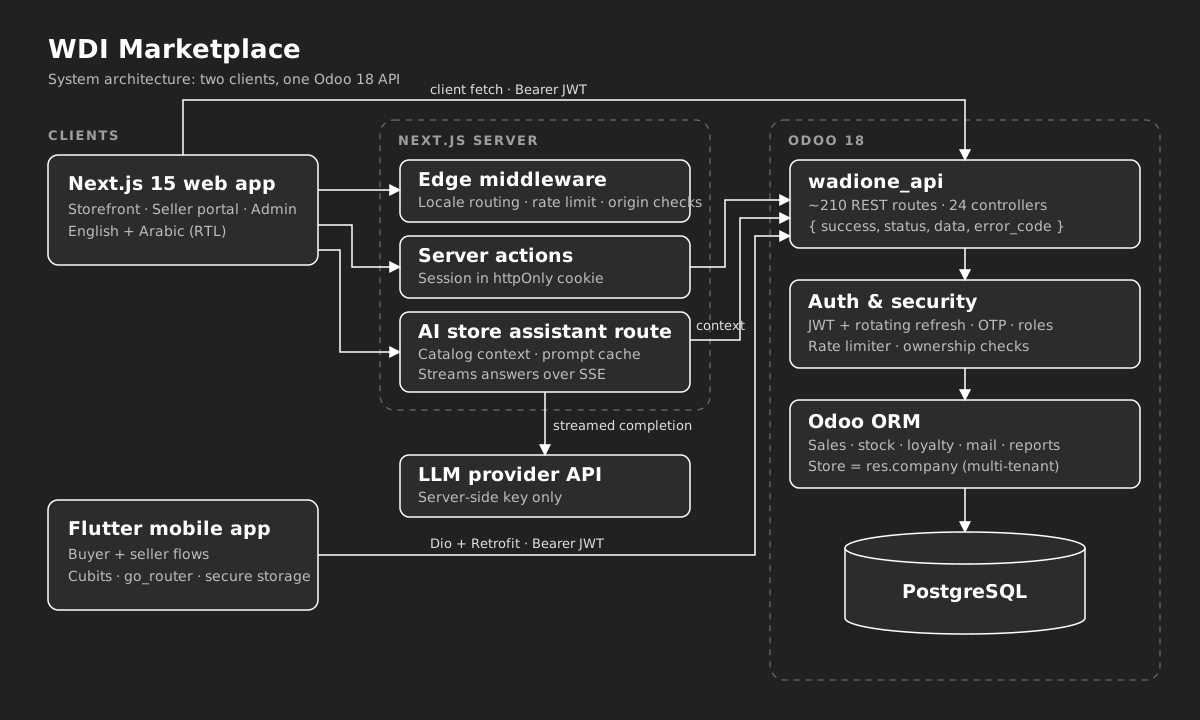
TOKEN_EXPIRED, OUT_OF_STOCK and PRICES_CHANGED, which made token refresh and checkout recovery deterministic.Vitest and Playwright journeys on the web, Odoo tests and a live endpoint-security suite on the backend, 27 unit and widget tests plus 16 device runs on mobile, all in one GitHub Actions workflow.
USER FLOWS
01Home feedPromotions, delivery address, categories and products in one scroll.
02Product detailsGallery, price and description before adding to the cart.
03Added to cartInstant confirmation, stock status and pay-later options.
04Shopping cartItems grouped by seller with quantities, totals and coupons.
05Delivery addressChoose a saved address or add a new one.
06Shipping methodPick each seller's delivery option separately.
07Payment methodCash on delivery or card payment.
08Order reviewAddress, payment and items by seller, checked before placing.
09Order summarySubtotal, VAT and shipping add up to one total.
10Order placedConfirmation with an order reference and next steps.
11My ordersOrder history with totals and payment method.
12Order trackingStatus timeline from confirmation to delivery, plus re-order.
13Create storeFour-step wizard starting with bilingual store details.
14Business addressStep two records the store's business address.
15KYC verificationSellers register as individuals or licensed businesses.
16KYC documentsLicense, tax certificate and bank proof uploaded as PDFs.
17Seller dashboardOrder snapshot, stock alerts and quick actions.
18Seller menuEarnings, orders, inventory, returns, reviews and messages.
19Earnings and payoutsBalance, commission and payout requests in one place.
20Order managementFilter orders by status; search by ID, customer or SKU.
21Order detailsFulfil an order: mark it delivered or cancel it.
22Web homeResponsive storefront with rotating campaigns and category navigation.
23Web cartCart with quantities, coupon and VAT-inclusive order summary.
24Store pageEach verified seller's storefront and catalog.
25Seller dashboardSales, orders, listings and store tools in one view.
26AI store assistantAsk about a store; answers come from its live catalog.
CONTACT
Have a role or a project in mind? Send me a message and I'll get back to you the same day.